When it comes to building a business, there are so many strategies, methods, and frameworks. In this blog post, we make sense of all the internet drama and turn those strategies into a growth system that increases your revenue and scales your business so you spend less time chasing customers and more time enjoying life. That way, you build a business that generates the income you need, with time to take flights and fool around.
What are business growth strategies?
A business strategy is a plan companies use to expand revenue, market share, or the value of the company. It's the roadmap or “how” they plan to acquire more customers, increase profits, or reach a specific goal.
As a small business owner, there are multiple strategies you can use to grow your business (literally thousands). One way to make sense of all the advice you hear online is the Product/Market Expansion Matrix.

Most likely the strategies you hear about will fall into one of these categories. For example, adding a new marketing platform would be Marketing Development (same products, new market-ing); adding a low-ticket offer to your business would be product development. Once you understand the core four growth strategies, you won't unsee it!
Growth strategies for businesses
Four major growth strategies based on the Product/Market Development Matrix.
Market Penetration
Selling more of your existing products to your current market. This could be through marketing campaigns, loyalty programs, seasonal sales, increasing how frequently your customers buy (subscriptions), and much more!
Market Development
Selling your existing products to a new market. This new market could be geographical (new state or country), demographic (moms vs single women), psychographic (selling vegan handbags to eco-conscious women vs fashion-forward women), or behavioural (high usage vs low usage).
Product Development
Selling a new product to your current market. Your existing customers already trust & know you, so creating a new offer around their next step is a great way to increase revenue. For example, if you sell vegan handbags, selling vegan wallets would be a great way to sell more to your existing audience. You can do this by researching & surveying your audience for complementary items or other problems they have.
Diversification
Selling new products to a new market. Here you're creating entirely new products for an entirely new market. You could be leveraging your brand power or existing capacity to brand out or building out a whole new segment of the business.
There are multiple ways to diversify your business.
Horizontal diversification: Creating a new product/service that still may appeal to your current marketing but is, overall, a different market/category. For example, Apple launching the iPhone after primarily being a computer-only company. Or a brand designer launching website design (new product, new market, but their existing customers may still purchase)
Vertical diversification: Creating a product/service that is upstream or downstream of their supply chain or production. For example, Starbucks (a coffee shop) acquiring a coffee roastery. Or a brand designer acquiring a printing company.
Concentric diversification: Creating a new product that is technologically or operationally related to your existing business. For example, Domino's (a pizza company) selling pasta. Or a brand designer offering social media template design (same graphic design skill used in a different way).
Conglomerate diversification: Creating an entirely different product/service that has little to no connection to the existing business. For example, Amazon selling books and selling cloud computing. Or a brand designer selling homemade jewelry.
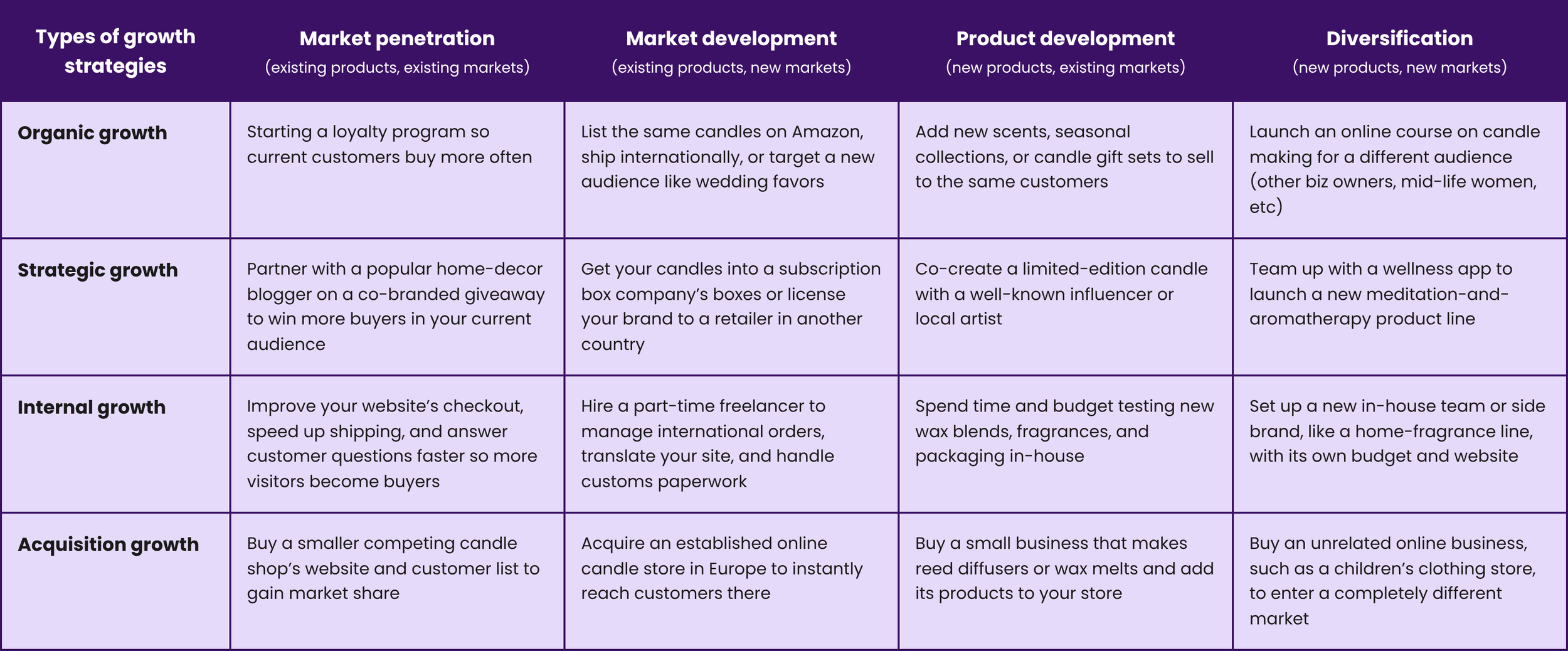
Four Types of Growth Strategies
There are other ways to grow your company outside of the four strategies above. Consider these the “how” or the types of growth you can achieve.
Organic growth:
When a company uses its own resources, customer relationships, and/or products to increase revenue.
Social media
Word of mouth/Referrals
Networking
Strategic growth:
When a company leverages other companies, alliances, or partnerships to increase revenue or reach new customer value
New partnerships
Paid Ads
Internal growth:
When a company improves operational efficiency or output to increase revenue or market share.
New Hires
Team Trainings
Software upgrades
Acquisition growth:
When a company buys or merges with another company in order to increase its capabilities, market share, or revenue.
Similar to diversification, there are multiple types of acquisition.
Forward acquisition: When a company acquires a company that distributes or buys the products/services it makes.
Horizontal acquisition: When a company acquires a company hiring in the industry or stage in the supply chain.
Backward acquisition: When a company acquires a company that supplies the products/services it needs for production.
Why business strategies fail
Business strategies fail because of implementation and execution. It is important to note that the strategy is just step 1. The execution of that strategy in your business is whether you take action or build a new process or system. So failure to execute is the main breaking point in every strategy.
Another way business strategies fail is through poor implementation or implementing the wrong strategy. Some strategies may not be a good fit for your business.
For example, if you're a specialty brick-and-mortar boutique, diversification is basically an oxymoron. If you diversify too much, you basically become a Walmart and lose the whole appeal that brought your customers into the store.
That why it important to use discernment with these strategies, it not important to try them all. In fact, you only need one of these strategies to hit six figures in revenue. And maybe 1-2 of these strategies to hit $1M. It's about the quality of the execution, not the quantity of how many tactics or strategies you can try in the next 3 months.
Tips for creating a growth strategy for your business
Focus on revenue and cash flow: As a small business owner, market share is great. But cash in the bank is what pays the bills and keeps you in business. There is no point in being the go-to in your industry if you are broke!
Start with lowest-risk, but high-reward strategies: If the goal is to increase revenue, that doesn't automatically mean adding 12 new products. You could just start with adding a deal for repeat customers.
Understand your customer: Take time to survey your current customers and research the market you are entering. Going off of vibes is cool, but data is better!
Numbers, Numbers, and more Numbers: Make sure to track the before, during, and after as you implement your strategy. To drive impact, you need to understand where you are starting from, so consider pulling data from 3+ months back before making drastic changes.
Execute!: What's more important than planning? Action! Turn this strategy into a process or system that you can repeat.
What is a growth system?
A growth system is a set of connected solutions that operate together to drive predictable, repeatable, and scalable business expansion.
The purpose is to create stability, predictability, and consistency in the business. Ideally, the growth system initiates itself and runs in a loop. For example, a monthly dashboard that updates itself. Realistically, the growth system may include manual elements that need to be done in order for other steps in the process/system to be completed. For example, you may need to manually input data into a dashboard.
A growth system does not have to be technologically complicated; it can be as simple as a checklist you complete every month to ensure your marketing is done.
The most important part of a growth system is that it is compatible with you and your business! If you are not a techie person, it may not be a good idea to build your growth system on a platform you are unfamiliar with.
If you want growth system ideas, check out these 4 growth systems.
How do you create a growth system?
When creating a growth system in your business, understanding what your current capacity is and determining what is sustainable for you right now is key. The most important part of a system is being able to execute it repeatedly. Having an overcomplicated system that you do not know how to use. Is just a waste of time, as you will spend hours tweaking a new system that you don’t use next week!
The difference between trying strategies and having a growth system
Now, how does this apply to your business? A business growth strategy is the plan a company uses to reach a specific goal. While a growth system is the operator that turns that plan into repeatable execution.
All of these growth strategies are great in theory, but as a solopreneur, what really matters is turning these strategies into a system!
A strategy is a plan.
A growth system is the execution.
You don't want to hop around trying a different strategy every month. You want to implement one of these strategies into a system. Then refine that system over time. You will end up with a better growth system with more conversions, revenue and client versus if you built a new system every month. The difference between trying strategies and having a growth system is focus. You can scale your business with one strategy and one system, so pick one!
Tips for creating a growth system in your business
You wanna map out your new system in advance with every single step
You want to identify the Minimum Viable Product (MVP) of the system. What are the bare bones that need to be included?
You want to have it easy to implement, execute, and reset (for those days where you fall off)
You want to approach it with an experimental mindset so that you understand that it is a growing process and that it’s not going to be perfect on the first try.
Work on your mindset; as the founder, how productive you are is important.
Conclusion
Here’s what this means for you. You probably have an inkling of what you should do next in your business. Use your newfound understanding of the different growth strategies to solidify that idea, and then turn that strategy into a growth system that you can utilize in your business to increase your revenue and scale your business.
If you want help with strategy, book a 90-minute intensive. If you want help building a personalized growth system, join 1:1 coaching.

Welcome to Growthalista
Helping YOU Grow in Your Next Self with Burnout & Mental Health advice rooted in the real world!

Eliminate 80% of your To-do list!